Drainage • 4 min read
French drain vs. trench drain: which water are you trying to move?
A drainage system is a route: water enters, moves through it, and leaves somewhere appropriate. The right starting point is understanding that route.
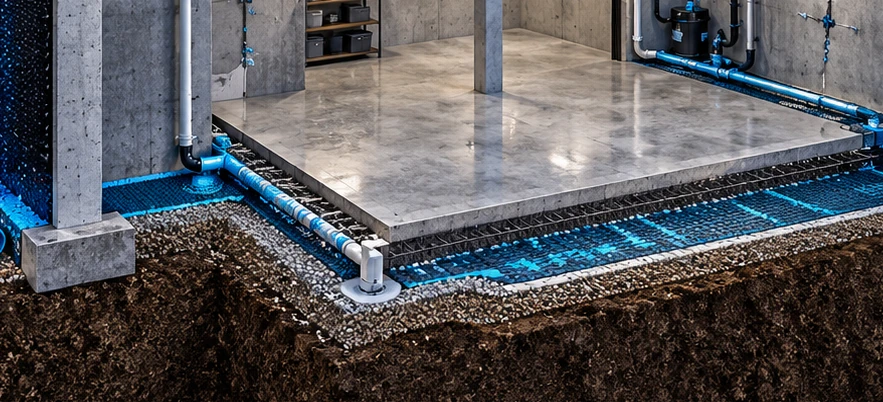
French drains typically collect along a permeable subsurface path. Grated trench or channel drains intercept surface runoff. Terminology can vary—ask to see the detail.
The practical difference
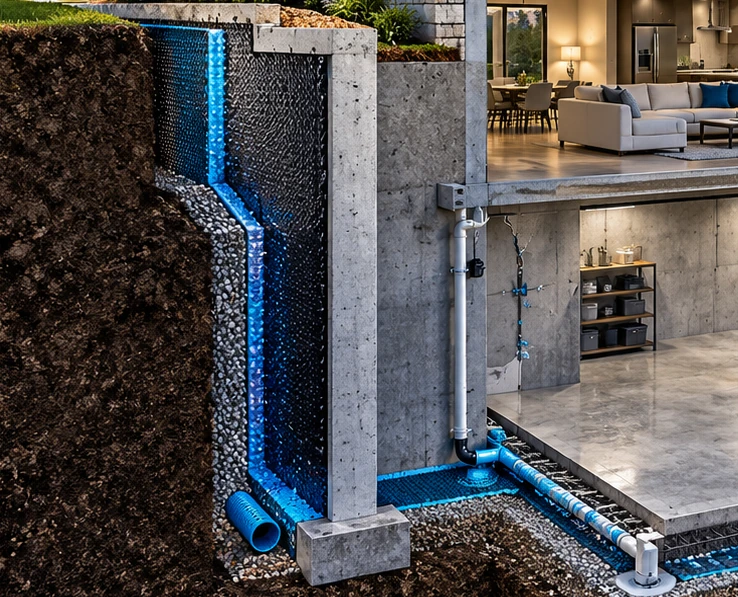
A conventional French drain uses a permeable collection zone, often with aggregate and perforated pipe, to collect water along its length. It can address subsurface water and, depending on the arrangement, surface water entering through the collection zone. NDS describes this distributed collection as distinct from capturing water at a single point. [1]
A grated trench or channel drain is typically a linear surface collector. Its visible grate intercepts runoff crossing a driveway, patio, walkway, or similar hardscape and routes it into connected drainage. NDS identifies hardscape surface-water collection as an application for its channel drains. [2]
Contractors and homeowners sometimes use these terms differently. Rather than debating the name, ask to see a cross-section: what is open at the surface, what is perforated below it, and where does the collected water leave? That drawing is more useful than a category label.
Match the conversation to the observation
Describe the problem in ordinary language. Is water running across paving toward a garage opening? Is a planting bed staying saturated beside a foundation? Is moisture appearing below grade? Those observations frame different drainage questions without requiring you to specify a system.
A hypothetical driveway with visible runoff at a threshold may prompt a surface-interception discussion. A persistently saturated strip of soil may prompt investigation of subsurface collection. The examples illustrate the difference; they are not a diagnosis of every property with similar symptoms.
A plan can also use more than one collection method. What matters is whether the elements connect into a coherent route and whether the assessment supports each one. More drains do not automatically mean a better design.
The outlet is not an afterthought
Ask where water will go before discussing the appearance of a grate. Is the outlet accessible? Is it lower than the collection point, or is a pump needed? Who evaluates the site's soils and the suitability of infiltration? Who confirms the applicable local requirements and avoids discharging onto neighboring property?
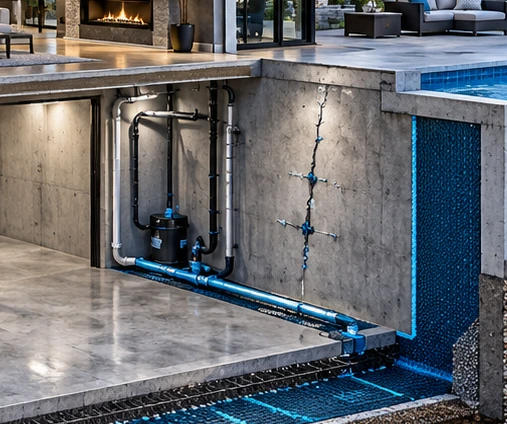
For foundation drainage, the Building America Solution Center describes discharge away from the building and warns against putting pumped water back next to the foundation. [3] A collection system with an unsuitable destination does not complete the water-management task.
Document any existing buried system if plans are available. “Connect to the old drain” should come with an explanation of how that drain's location, condition, and destination will be confirmed. Unknown infrastructure is a question to investigate, not an assumption to hide inside a quote.
Ask about access and maintenance
Clarify how the proposed system will be inspected and cleaned. Surface grates may need accessible debris removal, while buried systems may need appropriately located access points. NDS notes removable grates as a maintenance feature of its channel-drain system. [2] The specific inspection routine should come from the installed system's requirements.
Ask what landscaping or paving can be placed over or near the system and what must remain reachable. Have the final route recorded before it is concealed. A few labeled handover photos can save confusion when a future landscaping or renovation project begins.
Also ask who handles utility checks, excavation planning, restoration, and protection of adjacent structures. This guide is a planning resource, not an instruction to dig beside a footing yourself.
Compare proposals with the same checklist
Write down the collection method, proposed route, discharge destination, access points, restoration, and maintenance. Request clarification when one proposal includes these details and another supplies only a total length and price.
There is no universal price or depth in this article because those numbers depend on the actual project. A generic online dimension should not replace the drainage plan for your home. The most useful quote makes its assumptions visible.
Start with the water path
Our French and trench drain services bring the two approaches into one conversation. For rain-related basement concerns, also read what to check after rain. Bring a video of the water path taken safely during an event, plus a sketch of where you believe existing drains lead.
Before your next conversation
A little preparation goes a long way.
0 of 4 items noted · This checklist stays in this page.
Sources & further reading
Technical background comes from the resources below. Manufacturer guidance is system-specific and does not imply a brand partnership or suitability for every project. Sources checked September 17, 2026.
- NDS — French Drain Installation Guide ↗
- NDS — 12-inch Pro Series Channel Drains ↗
- Building America Solution Center — Drains and Sump Pumps ↗
This guide is not a property diagnosis, structural assessment, product specification, or substitute for applicable professional guidance. Project conditions, manufacturer instructions, and local requirements must be evaluated for the actual work.