Foundations • 4 min read
Foundation crack injection: stopping a leak is not the same as repairing structure
A crack may be a water pathway, a sign of movement, or both. A sound repair discussion separates those questions instead of treating every opening alike.
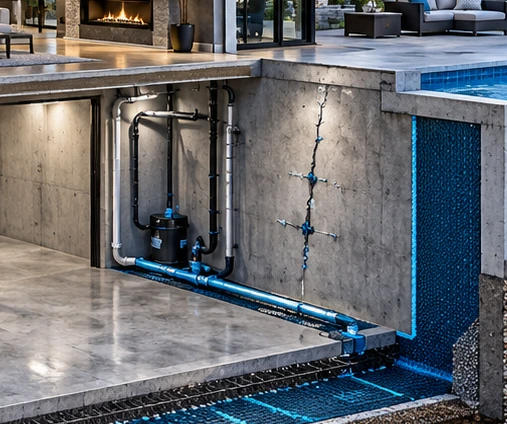
Ask what caused the crack and what the proposed repair is designed to achieve. A dry surface alone does not establish structural adequacy.
Separate two very different objectives
One objective is reducing water passage through an opening. Another is restoring or addressing structural performance. These objectives can overlap, but they are not automatically satisfied by the same material or method.
Sika's injection guidance distinguishes rigid materials used for applications such as structural repair from flexible materials used for water-stopping applications. Its broader epoxy guidance also notes the role of movement and leakage in choosing an injection approach. [1][2] That is why a request for “crack injection” should begin with assessment, not a product selected from a photo.
A homeowner's useful question is: “Are you proposing a leak seal, a structural repair, or a combination—and what supports that choice?” This does not require technical expertise. It requires the scope to be explained plainly.
What to record before the visit
Photograph the entire wall and the opening in context. A close-up without surroundings can be misleading. Include corners, openings, adjoining surfaces, and the floor edge when it is safe and practical to do so.
Record when you first noticed the crack, whether it has visibly changed, whether moisture appears nearby, and whether anyone has previously sealed or covered it. Save available repair invoices and older photos. Do not conceal the area just to make it look better before an assessment.
If measurements are practical without risk, include a scale in the photograph, but do not use a single measurement to declare a crack harmless. An assessor may need to evaluate its pattern, depth, movement history, material, loading context, and adjacent conditions.
Why material names do not settle the question
“Epoxy” and “polyurethane” describe families of products, not universal repair instructions. Suitability depends on the specific product, the condition being treated, and the preparation and installation requirements. A product's marketing category is not enough information to select it for a particular wall. [1][2]
Ask for the exact product or system intended for your project, the repair objective, and any limitations the installer expects. Ask how the plan accounts for a crack that is wet or may continue to move. This guide does not provide injection pressures, mixing ratios, or installation steps because those belong to the assessed repair and the manufacturer's instructions.
Be cautious about promises that every visible crack can be solved identically. A clear explanation of uncertainty is more useful than a blanket assurance that one material handles everything.
Look beyond the opening
Even when a crack is the visible entry point, the surrounding water conditions remain relevant. Ask whether runoff, grading, and drainage are also being evaluated. Repairing one path and addressing the water pressure around the wall are different parts of the same investigation.
The Building America Solution Center describes exterior grading and drainage as ways to limit water saturation near foundations. [3] That does not establish the cause of your crack, but it supports looking at the property around the wall rather than only at the line on its surface.
For example, a recurring leak following heavy rain may justify asking how the proposed repair relates to exterior water conditions. A crack appearing in a new addition may call for different questions about the building and construction history. These are discussion prompts, not diagnostic rules.
Know when to escalate the assessment
Ask for evaluation by an appropriately qualified structural professional when there is concern about movement, displacement, bowing, or stability. Do not interpret this article or the site's visual model as a structural assessment. If part of the building appears unstable, keep people away and use the appropriate urgent professional or emergency channel.
A waterproofing proposal should be able to identify what it does not cover. If structural evaluation is outside the contractor's scope, document who will address it and how that work affects the proposed water repair.
Request a clear handover
Keep the assessed scope, materials, photographs, written terms, and any monitoring instructions. Ask how the repair will be checked and what should prompt another call. A useful handover lets you distinguish a completed task from a broader issue that still needs attention.
Use our crack injection service page to start the conversation. Bring your observations and history; do not feel you need to arrive with a repair method already chosen.
Before your next conversation
A little preparation goes a long way.
0 of 4 items noted · This checklist stays in this page.
Sources & further reading
Technical background comes from the resources below. Manufacturer guidance is system-specific and does not imply a brand partnership or suitability for every project. Sources checked September 17, 2026.
- Sika — Injection Technologies and Their Applications ↗
- Sika — Multi-Purpose Epoxies ↗
- Building America Solution Center — Final Grade Slopes Away from Foundation ↗
This guide is not a property diagnosis, structural assessment, product specification, or substitute for applicable professional guidance. Project conditions, manufacturer instructions, and local requirements must be evaluated for the actual work.